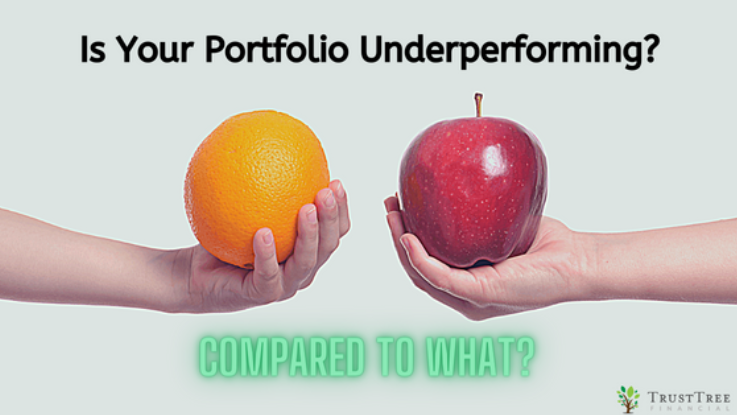
Compared to What?
11/13/2023Blog Categories
Ah, we restless humans.
Sometimes, it pays to strive for greener grass.
But as an investor, second-guessing a stable strategy can leave you in the weeds. Trading in reaction to excitement or fear tricks you into buying high (chasing popular trends) and selling low (fleeing misfortunes), while potentially incurring unnecessary taxes and transaction costs along the way.
Still, what do you do if it feels as if your investments have been underperforming? It helps to lead with this key question, to decide if the impression is real or perceived:
How am I doing so far … compared to what?
You might get lucky and buy in ahead of the peaks.
You might ride the surges while they last.
You may manage to jump out before the fads fade.
Unfortunately, even experts cannot foresee the countless coincidences that can squash a high-flying holding, or send a different one soaring. To succeed, I often tell people you must correctly—and repeatedly—decide when to get in, and when to get out.
And you must do so in markets where unpredictable hot hands can run anywhere from days to years.
Remember too, if you simply invest some of your money in the global stock market and sit tight, you’ll probably already own today’s hot holdings. You’ll also automatically hold some of the next big winners, before they surge (effectively buying low).
Rather than comparing your investments to the latest sprinters, be the tortoise, not the hare. Get in, stay in, and focus on your own finish line. It’s the only one that matters.
Maybe you’re seeing reports of “the market” returning several percentage points more than you have lately. What gives?
Remember, when a reporter, analyst, or others discuss market performance, they’re usually citing returns from the S&P 500 Index, the DJIA, or a similar proxy. These popular benchmarks often represent one asset class: U.S. large-cap stocks. As such, it’s highly unlikely your own portfolio will always be performing anything like this single source of expected returns.
Most investors instead prefer to balance their potential risks and rewards. For example, if your portfolio is a 50/50 mix of stocks and bonds, you should expect it to underperform an all-stock portfolio over time. But it also should deliver more dependable (if still not guaranteed) returns in the end, along with a relatively smoother ride along the way.
Even if you’re more heavily invested in stocks than bonds, a well-diversified stock portfolio will typically include multiple sources of risks and returns. I am referring to areas such as U.S., international, and emerging market stocks; small- and large-cap stocks; value and growth stocks; and other underrepresented sources of expected return.
Thus, we advise against comparing your portfolio’s performance to “the market.” Usually, any variance simply means your well-structured, globally diversified portfolio is working as planned.
Your portfolio should be structured to reflect your financial goals and your ability to tolerate the risks involved in pursuing your desired level of long-term growth. Thus, a more appropriate comparison is made among the “building block” investments available to achieve this ideal.
Once you’ve built a portfolio that reflects your goals and risk tolerances, there are really only two reasons your particular selections might underperform similar investments:
Your investments may be accurately capturing the returns you’re seeking.
It’s also possible that you aren’t spending too much to make this happen.
And if you (or your portfolio advisor) don’t have to make constant adjustments just to stay on course … any other comparisons become largely irrelevant to your investment journey.
Yet it’s very possible to avoid inappropriate performance comparisons. It’s also likely to identify appropriate solutions across shifting times and unfolding events.
I have these conversations frequently, and I’d love to continue helping people with that!
One thing I am certain of: we’ll continue to see roaring bull and scary bear markets alike. Along the way, we team up with you to address these critical “Compared to what?” questions about your investments.
It’s what we do to ensure you can accurately assess where you stand, and where you’d like to go from here.
Please be in touch if we can tell you more.
Brandon
Sometimes, it pays to strive for greener grass.
But as an investor, second-guessing a stable strategy can leave you in the weeds. Trading in reaction to excitement or fear tricks you into buying high (chasing popular trends) and selling low (fleeing misfortunes), while potentially incurring unnecessary taxes and transaction costs along the way.
Still, what do you do if it feels as if your investments have been underperforming? It helps to lead with this key question, to decide if the impression is real or perceived:
How am I doing so far … compared to what?
Compared to the Stocks du Jour?
It’s easy to be dazzled by popular stocks or sectors that have been earning magnitudes more than you have, and wonder whether you should get in on the action.You might get lucky and buy in ahead of the peaks.
You might ride the surges while they last.
You may manage to jump out before the fads fade.
Unfortunately, even experts cannot foresee the countless coincidences that can squash a high-flying holding, or send a different one soaring. To succeed, I often tell people you must correctly—and repeatedly—decide when to get in, and when to get out.
And you must do so in markets where unpredictable hot hands can run anywhere from days to years.
Remember too, if you simply invest some of your money in the global stock market and sit tight, you’ll probably already own today’s hot holdings. You’ll also automatically hold some of the next big winners, before they surge (effectively buying low).
Rather than comparing your investments to the latest sprinters, be the tortoise, not the hare. Get in, stay in, and focus on your own finish line. It’s the only one that matters.
Compared to “the Market”?
What if your investments seem to be underperforming not just the high-flyers, but the entire market?Maybe you’re seeing reports of “the market” returning several percentage points more than you have lately. What gives?
Remember, when a reporter, analyst, or others discuss market performance, they’re usually citing returns from the S&P 500 Index, the DJIA, or a similar proxy. These popular benchmarks often represent one asset class: U.S. large-cap stocks. As such, it’s highly unlikely your own portfolio will always be performing anything like this single source of expected returns.
Most investors instead prefer to balance their potential risks and rewards. For example, if your portfolio is a 50/50 mix of stocks and bonds, you should expect it to underperform an all-stock portfolio over time. But it also should deliver more dependable (if still not guaranteed) returns in the end, along with a relatively smoother ride along the way.
Even if you’re more heavily invested in stocks than bonds, a well-diversified stock portfolio will typically include multiple sources of risks and returns. I am referring to areas such as U.S., international, and emerging market stocks; small- and large-cap stocks; value and growth stocks; and other underrepresented sources of expected return.
Thus, we advise against comparing your portfolio’s performance to “the market.” Usually, any variance simply means your well-structured, globally diversified portfolio is working as planned.
Compared to a Similarly Structured Portfolio?
At last, we reach a comparison that makes more sense.Your portfolio should be structured to reflect your financial goals and your ability to tolerate the risks involved in pursuing your desired level of long-term growth. Thus, a more appropriate comparison is made among the “building block” investments available to achieve this ideal.
Once you’ve built a portfolio that reflects your goals and risk tolerances, there are really only two reasons your particular selections might underperform similar investments:
- Poor fund management: Are your products or solutions accurately capturing the specific sources of return they’re meant to deliver?
- Excessive costs: Are there lower-cost choices for achieving the same aim?
Your investments may be accurately capturing the returns you’re seeking.
It’s also possible that you aren’t spending too much to make this happen.
And if you (or your portfolio advisor) don’t have to make constant adjustments just to stay on course … any other comparisons become largely irrelevant to your investment journey.
Compared to What?
Admittedly, it can be easier said than done. Otherwise, I probably wouldn’t be writing this article!Yet it’s very possible to avoid inappropriate performance comparisons. It’s also likely to identify appropriate solutions across shifting times and unfolding events.
I have these conversations frequently, and I’d love to continue helping people with that!
One thing I am certain of: we’ll continue to see roaring bull and scary bear markets alike. Along the way, we team up with you to address these critical “Compared to what?” questions about your investments.
It’s what we do to ensure you can accurately assess where you stand, and where you’d like to go from here.
Please be in touch if we can tell you more.
Brandon