Invest Windfall All At Once or Wait?
09/23/2024Blog Categories

Let’s start with a common investor question:
What do you do if you’ve just or otherwise enjoyed a recent windfall you’d like to invest?
Clients and investors will ask, “Should I invest the money right away—even if the market seems particularly high or low—or little by little over time?”
No wonder: Deciding how to invest a pot of money can indeed feel paralyzing. What if you put the money in, and the market promptly tanks?
Or what if you hesitate, and the market soars? It’s perfectly normal to worry that you’ll make the wrong move…or at least not the best one.
Investing a lump sum all at once or over time has its advantages and disadvantages. Let’s take a look at some of the factors to consider.
In the short term, the market can be a volatile place, with the potential for big ups and downs. If some or all of your money is going to be used for short-term goals—say, paying college tuition bills that are just a few years away—you may consider more conservative investments less affected by this volatility, like short-term bonds, treasuries, or CDs.
If you want that money to help you pursue long-term goals such as retirement, then investing in the stock market is likely worthwhile. Over the long term, volatility tends to smooth out and the markets have historically continued to move higher.
But of course, near-term market returns are not predictable. There could be a downturn after you invest your lump sum. If this potential for a setback bothers you, dollar-cost averaging—investing a set amount of money at regular intervals—may be a more comfortable strategy.
For example, you could use dollar-cost averaging to invest that $120,000 in the market as $10,000 monthly installments over 12 months. Or as this graph indicates, $40,000 per month for the first 3 months:
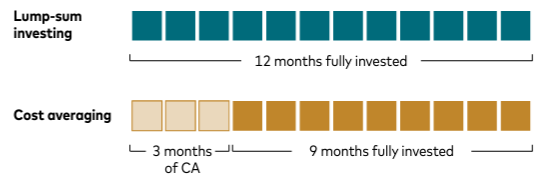
That way, when the market is at a high, your investment buys fewer fund shares. And when the market is lower, your investment buys more shares. The strategy helps you take advantage of the market’s natural ups and downs, helping you manage the average cost of the shares you buy.
However, be aware that the greater comfort of pacing your investments through dollar-cost averaging may come at a price. Research shows that lump-sum investing outperforms dollar-cost averaging 68% of the time. Said differently, backtesting the numbers indicates it is typically wiser to put it right to work and not delay.
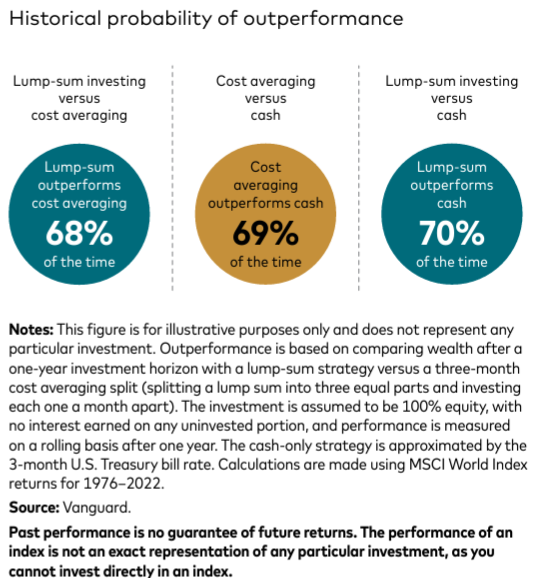
Notably, investing it all now or over time still tends to outperform doing nothing (i.e. sitting in cash waiting for “the right time”).
So, ask yourself: Is maximizing expected returns your top priority? If so, the lump-sum approach might make the most sense for you.
On the other hand, the same research suggests the expected outperformance is not by a large margin. So if the specter of potential investment losses might keep you awake at night, it may be worth taking a small hit to use dollar-cost averaging, especially if it will reduce the chance of panic-induced selling that effectively locks in even greater losses.
Delaying putting cash in the market is a form of market timing—buying or selling shares in an attempt to predict future market movements. This is a complicated game you’re unlikely to win.
Consider that average equity fund investor returns trailed the market (as proxied by the S&P 500) by 5.5% in 2023, largely due to trying to time to the market. Both lump-sum investing and dollar-cost averaging help you avoid this behavior and take advantage of the tendency for the market to grow over the long term.
And this is what you need to meet your long-term financial goals. The important thing is to choose the strategy that will allow you to stick to your long-term plan.
Unsure how to invest some of your cash holdings? Reach out. I’d be happy to discuss which option best suits your needs.
Brandon
What do you do if you’ve just or otherwise enjoyed a recent windfall you’d like to invest?
- Did you receive a big bonus at work?
- Inherit some money?
- Sell a business?
- Change jobs and have a 401k Rollover?
Clients and investors will ask, “Should I invest the money right away—even if the market seems particularly high or low—or little by little over time?”
No wonder: Deciding how to invest a pot of money can indeed feel paralyzing. What if you put the money in, and the market promptly tanks?
Or what if you hesitate, and the market soars? It’s perfectly normal to worry that you’ll make the wrong move…or at least not the best one.
Investing a lump sum all at once or over time has its advantages and disadvantages. Let’s take a look at some of the factors to consider.
Begin with Your Goals
Before making any investment moves, first consider what you want to use your money for. Sounds cliche, but think about it for a sec.In the short term, the market can be a volatile place, with the potential for big ups and downs. If some or all of your money is going to be used for short-term goals—say, paying college tuition bills that are just a few years away—you may consider more conservative investments less affected by this volatility, like short-term bonds, treasuries, or CDs.
If you want that money to help you pursue long-term goals such as retirement, then investing in the stock market is likely worthwhile. Over the long term, volatility tends to smooth out and the markets have historically continued to move higher.
Compare Lump-Sum Investing vs. Dollar-Cost Averaging
When you invest in a lump sum, all your money is exposed to the market right away. If the market is on an upward track, you can take advantage of immediate gains. Let’s say we’ve got $120,000 to invest. You could invest $120k on Day #1 and move on.But of course, near-term market returns are not predictable. There could be a downturn after you invest your lump sum. If this potential for a setback bothers you, dollar-cost averaging—investing a set amount of money at regular intervals—may be a more comfortable strategy.
For example, you could use dollar-cost averaging to invest that $120,000 in the market as $10,000 monthly installments over 12 months. Or as this graph indicates, $40,000 per month for the first 3 months:
That way, when the market is at a high, your investment buys fewer fund shares. And when the market is lower, your investment buys more shares. The strategy helps you take advantage of the market’s natural ups and downs, helping you manage the average cost of the shares you buy.
However, be aware that the greater comfort of pacing your investments through dollar-cost averaging may come at a price. Research shows that lump-sum investing outperforms dollar-cost averaging 68% of the time. Said differently, backtesting the numbers indicates it is typically wiser to put it right to work and not delay.
Notably, investing it all now or over time still tends to outperform doing nothing (i.e. sitting in cash waiting for “the right time”).
So, ask yourself: Is maximizing expected returns your top priority? If so, the lump-sum approach might make the most sense for you.
On the other hand, the same research suggests the expected outperformance is not by a large margin. So if the specter of potential investment losses might keep you awake at night, it may be worth taking a small hit to use dollar-cost averaging, especially if it will reduce the chance of panic-induced selling that effectively locks in even greater losses.
Whatever You Do, Don’t Delay Long
Historically, stocks and bonds outperform cash holdings over the long term. It’s critical to start investing as soon as possible to take advantage of this outperformance.Delaying putting cash in the market is a form of market timing—buying or selling shares in an attempt to predict future market movements. This is a complicated game you’re unlikely to win.
Consider that average equity fund investor returns trailed the market (as proxied by the S&P 500) by 5.5% in 2023, largely due to trying to time to the market. Both lump-sum investing and dollar-cost averaging help you avoid this behavior and take advantage of the tendency for the market to grow over the long term.
And this is what you need to meet your long-term financial goals. The important thing is to choose the strategy that will allow you to stick to your long-term plan.
Unsure how to invest some of your cash holdings? Reach out. I’d be happy to discuss which option best suits your needs.
Brandon