Understanding "No Tax on Tips"
06/17/2026Blog Categories

If you're one of the estimated six million taxpayers working in a job where you receive tips, you may be interested in learning more about the new "no tax on tips" deduction.
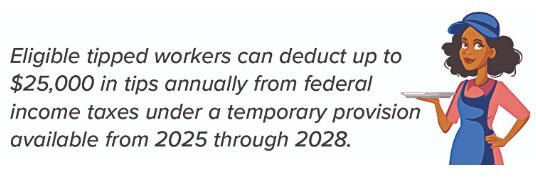
In 2025, the One Big Beautiful Bill Act established a temporary federal tax deduction to help reduce the tax liability of certain tipped workers for tax years 2025-2028. Employees and self-employed taxpayers may deduct up to $25,000 annually in qualified tips, provided they work in an occupation the IRS considers "customarily and regularly" tipped.
Qualified tips include voluntary cash tips and amounts paid by credit or debit card, including amounts received through tip-sharing arrangements. Automatic gratuities and mandatory service charges do not qualify.
The deduction is available whether the taxpayer claims the standard deduction or itemizes deductions. Self-employed individuals cannot claim a deduction exceeding the net income from the business in which the tips were earned.
Taxpayers who have a valid Social Security number and work in an eligible occupation, such as bartenders, waitstaff, casino dealers, hairdressers, valet attendants, taxi/rideshare drivers, baggage porters, and food delivery personnel, qualify for the deduction.
Here's something to watch: Married couples must file a joint return, while couples filing separately are not eligible. Employers must report all their employees' tip income to the IRS or Social Security Administration.
A complete list of the 68 occupations across eight industries that qualify for the deduction is available at irs.gov.
The deduction begins to phase out for single filers with modified adjusted gross income (MAGI) over $150,000 or over $300,000 for married couples filing jointly. The deduction is reduced by $100 for every $1,000 above these thresholds.
In 2025, the IRS permitted taxpayers to use Form W-2 (Box 7), employer tip reports, Form 4137, and personal tip logs to report qualified tips. In 2026, taxpayers claiming the deduction will use Schedule 1-A, while employers will be required to separately report qualified tips on Forms W-2 and certain 1099s.
Each state will decide whether to adopt, modify, or reject the provision, so taxpayers should check with their state tax agency to determine the tax treatment of tip income.
So there you have it - if you or someone in the family collects tips as a source of income!
Brandon
In 2025, the One Big Beautiful Bill Act established a temporary federal tax deduction to help reduce the tax liability of certain tipped workers for tax years 2025-2028. Employees and self-employed taxpayers may deduct up to $25,000 annually in qualified tips, provided they work in an occupation the IRS considers "customarily and regularly" tipped.
Qualified tips include voluntary cash tips and amounts paid by credit or debit card, including amounts received through tip-sharing arrangements. Automatic gratuities and mandatory service charges do not qualify.
The deduction is available whether the taxpayer claims the standard deduction or itemizes deductions. Self-employed individuals cannot claim a deduction exceeding the net income from the business in which the tips were earned.
Taxpayers who have a valid Social Security number and work in an eligible occupation, such as bartenders, waitstaff, casino dealers, hairdressers, valet attendants, taxi/rideshare drivers, baggage porters, and food delivery personnel, qualify for the deduction.
Here's something to watch: Married couples must file a joint return, while couples filing separately are not eligible. Employers must report all their employees' tip income to the IRS or Social Security Administration.
A complete list of the 68 occupations across eight industries that qualify for the deduction is available at irs.gov.
The deduction begins to phase out for single filers with modified adjusted gross income (MAGI) over $150,000 or over $300,000 for married couples filing jointly. The deduction is reduced by $100 for every $1,000 above these thresholds.
In 2025, the IRS permitted taxpayers to use Form W-2 (Box 7), employer tip reports, Form 4137, and personal tip logs to report qualified tips. In 2026, taxpayers claiming the deduction will use Schedule 1-A, while employers will be required to separately report qualified tips on Forms W-2 and certain 1099s.
Each state will decide whether to adopt, modify, or reject the provision, so taxpayers should check with their state tax agency to determine the tax treatment of tip income.
So there you have it - if you or someone in the family collects tips as a source of income!
Brandon